
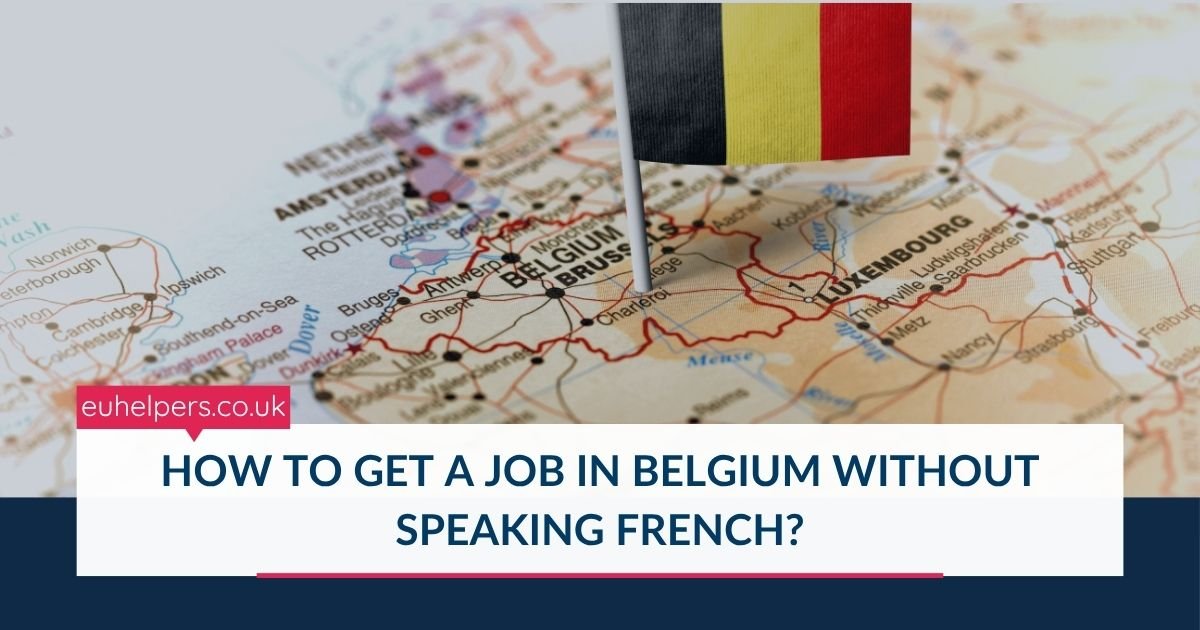
If you are asking how to get a job in Belgium without speaking French, the answer is more encouraging than most people expect. Belgium is one of the most multilingual, internationally connected countries in Europe, and a significant portion of its professional job market operates entirely or predominantly in English — not French, not Dutch, but English. While it is not necessary to be able to speak French, Dutch, or German — the three official languages — doing so would certainly be an added bonus on your CV. Belgium is home to an increasing number of multinational businesses and EU institutions, and its population of 11.3 million speak a range of languages, making this one of Europe's most cosmopolitan and appealing places to work for foreign nationals.
Belgium sits at the geographic and political heart of Europe. Brussels is the de facto capital of the European Union, the official seat of NATO, and the home of hundreds of international organizations, NGOs, and global corporations. Belgium sits at the center of a triangle between the big economies of Germany, France, and the UK, and the Belgian capital of Brussels serves as the capital of the European Union. This has made Belgium an attractive home for NGOs and big international businesses, and an attractive and competitive job market for international workers.
Some surveys show that 55% of the Belgian population can speak conversational English, while 33% of Brussels residents speak it fluently. English is so normal in Belgium that some people want to make it one of the official languages.
This guide gives you everything you need to successfully find a job in Belgium as an English speaker — which cities and sectors offer the best English-language opportunities, how to target your application, how the Belgian work permit system works for non-EU nationals, the salary requirements, the documents you need, the step-by-step process, and how EU Helpers can connect you with a verified Belgian employer and guide you through the entire process at no cost to you.
Understanding Belgium's Language Landscape
Before diving into strategy, it is important to understand Belgium's linguistic geography, because where you live and work in Belgium matters enormously when it comes to language requirements.
Belgium is divided into three distinct linguistic regions. Flanders in the north speaks Dutch, known locally as Flemish. Wallonia in the south speaks French. The Brussels-Capital Region is officially bilingual, with both French and Dutch as official languages, though French dominates in practice. A small German-speaking community exists in the east.
If you only speak English, you should aim for larger companies and startups with an international culture. Focus on cities like Brussels and Antwerp, as there are more English-speaking job opportunities in larger cities.
In Brussels, the official languages are French and Dutch, but the language on the streets is French. Around 90% of the job listings you will find require either Dutch or French or both. If you can only speak English for the time being, you should apply at international companies.
This regional reality means your job search strategy must be geographically targeted. Brussels and Antwerp are far and away the best cities for English-speaking professionals. Both have large international business communities, strong startup ecosystems, and significant concentrations of multinational company headquarters. Ghent has a growing English-speaking tech and creative sector. Outside these cities, job opportunities for English-only speakers become significantly more limited.
The practical advice is this: if you are moving to Belgium with English as your primary professional language, target Brussels and Antwerp above all else, focus on international companies and EU institutions, and begin learning either Dutch or French as quickly as possible to dramatically expand your options over time.
Where English Is Genuinely Enough
Contrary to what many people assume, there are specific, well-defined sectors and employer types in Belgium where English is not just tolerated but is the primary working language. Understanding these clearly will focus your job search effectively.
EU Institutions and International Organizations
Brussels is unique in Europe as the headquarters of both the European Union's core institutions — the European Commission, the European Parliament, the European Council, and the Council of the EU — and NATO, the world's largest military alliance. Both of these umbrella organizations bring hundreds of supporting institutions, agencies, NGOs, lobbying organizations, think tanks, consultancies, and law firms that all operate in English.
Belgium serves as the capital of the European Union. As the headquarters for the European Union and NATO, Brussels attracts an array of international professionals. Many full-time employees work in EU institutions or international NGOs based in Brussels.
English is the working language of EU institutions, NATO, and the vast majority of organizations that exist to engage with them. Policy analysts, communications specialists, legal advisors, project managers, data analysts, IT professionals, finance specialists, translators, and administrative staff are all consistently needed in this ecosystem, and English fluency is the primary language requirement for most of these roles.
Technology and IT
Next to IT specialists, there is a demand for specialized technicians, project managers, administrative and sales staff, as well as education and healthcare professionals in Belgium. The different regions define their own list of shortage occupations every year.
Belgium's technology sector — concentrated particularly in Brussels, Antwerp, and Ghent — operates extensively in English. Major global technology companies including Microsoft, Google, Oracle, and SAP all have Belgian operations. A thriving local startup and scale-up ecosystem has developed particularly in Brussels and Antwerp, and these companies typically operate in English as their primary working language regardless of their Belgian context.
The most popular positions for English speakers include sales representatives and software engineers and developers. Software developers, data scientists, cybersecurity analysts, cloud engineers, DevOps specialists, product managers, and UX designers are all in consistent demand in Belgium's technology sector, and English is standard across all of these roles.
Finance and Professional Services
Brussels, Antwerp, and to some extent Liège all have significant financial services sectors. Major international banks, insurance companies, investment managers, and professional services firms all operate Belgian offices that recruit English-speaking professionals. Accounting, financial analysis, risk management, compliance, and treasury roles are widely available for English speakers in these multinational environments.
Belgium boasts competitive salaries, with the average annual salary around €59,285. Sectors such as finance, technology, and engineering actively seek international talent. Foreign professionals, especially those with multilingual abilities, are highly valued in Belgium's diverse job market.
Engineering and Manufacturing
Belgium has a strong industrial heritage and a thriving modern manufacturing and engineering sector, particularly in Flanders. Major international manufacturers including Volvo, Audi, and dozens of chemical and pharmaceutical companies all have Belgian facilities where English is used as the primary working language for technical and managerial roles. Engineers and technical specialists from abroad are regularly hired into these environments without requiring local language proficiency.
Pharmaceuticals and Life Sciences
Belgium is one of Europe's most important pharmaceutical and biotechnology hubs, home to the European operations of major global pharmaceutical companies including Janssen, UCB, Pfizer, and many others. Moving to Antwerp? Check out companies like Janssen for pharmaceutical and biotech opportunities where English is the working language. Research scientists, clinical trial specialists, regulatory affairs professionals, quality assurance managers, and medical affairs specialists are all in demand and work predominantly in English.
Customer Service and Business Process Outsourcing
Brussels and Antwerp host significant business process outsourcing and shared service operations for global companies, and many of these require English-language customer service representatives, technical support specialists, and back-office processing staff. These roles are among the most accessible for English-speaking workers without prior Belgian work experience.
English Language Teaching
Belgium, with its multicultural landscape, is an ideal destination for TEFL teachers. The country's diverse educational landscape offers a wealth of opportunities for educators to share their knowledge and make a lasting positive impact on students of all ages.
English language teachers are in consistent demand across Belgium, in private language schools, international schools, corporate language training programs, and increasingly in public schools as bilingual education expands. A TEFL or CELTA certification is the standard minimum requirement, and being a native or near-native English speaker is a significant advantage.
Best Cities for English-Speaking Jobs in Belgium
Brussels
Brussels is by far the best city in Belgium for English-speaking foreign workers. A lot of expats find jobs via LinkedIn. For location, try your area, then Brussels, Antwerp, Mechelen, and Ghent. Brussels is home to the EU institutions, NATO, hundreds of international NGOs and think tanks, dozens of major multinational corporate headquarters, and a thriving startup and tech community. The city's English-friendly culture extends far beyond the workplace — restaurants, cafés, social venues, and daily life in the European Quarter and the international neighborhoods of Ixelles and Etterbeek are thoroughly English-accessible.
If you are in Brussels, look for companies like NATO, Avnet, Electrolux, or Sopra Banking for English-speaking employment opportunities.
Antwerp
Antwerp is Belgium's second city and one of Europe's most important ports, logistics hubs, and diamond trading centers. It has a thriving English-speaking professional community, particularly in logistics and supply chain management, the diamond industry, fashion and creative industries, pharmaceuticals, and technology. Moving to Antwerp? Check out Wunderman Thompson, Mazda, and Janssen for English-speaking positions.
Katoen Natie is a very popular option for foreigners in Antwerp. They usually hire through interim agencies including Synergie, Konvert, Manpower, and Ago. Antwerp's port-related logistics sector is one of the most accessible for foreign workers without Dutch language skills, as English serves as the international language of maritime and logistics operations.
Ghent
Ghent has a growing technology and creative sector and hosts significant international business activity. Those in Ghent can look for companies like StoryMe, Volvo, In the Pocket, and others for English-speaking positions. Ghent's university sector is also internationally oriented and provides English-language research and academic positions.
Key Job Highlights — Working in Belgium as an English Speaker
| Factor | Detail |
|---|---|
| Best Cities for English Jobs | Brussels, Antwerp, Ghent, Leuven |
| Top English-Speaking Sectors | IT, EU Institutions, Finance, Pharma, Engineering, Logistics, Teaching |
| Average Annual Salary | Approximately €59,285 (all sectors combined) |
| IT/Technology Monthly Salary | €3,500 – €6,500 per month |
| Finance/Professional Services | €3,000 – €6,000 per month |
| Engineering | €2,800 – €5,500 per month |
| Pharma/Life Sciences | €3,200 – €6,000 per month |
| Highly Qualified Worker Salary Threshold | €46,632/year (Flanders) / €50,310/year (Brussels and Wallonia) |
| EU Blue Card Salary Threshold | €55,181/year (Flanders) / €60,998/year (other regions) |
| Single Permit Processing Time | 3 to 4 months |
| Standard Contract Duration | 1 to 3 years, renewable |
| Working Hours | 38 hours per week standard |
| Paid Annual Leave | Minimum 20 days plus public holidays |
| 13th Month Bonus | Widely provided — equivalent to one additional month's salary |
| Path to Permanent Residence | 5 years of legal residence |
| Language Required | English sufficient in international companies and EU sector |
How Belgium's Work Permit System Works for Non-EU Workers
For non-EU foreign workers, understanding Belgium's work permit system is essential before you begin your job search. Belgium's system is regionally organized — the three regions of Flanders, Wallonia, and the Brussels-Capital Region each have their own rules and shortage occupation lists, and the appropriate region is determined by the location of your employer's principal place of work.
Since January 2019, any citizen from a non-European country who wants to stay and work more than 90 days in Belgium must be a Single Permit holder. The employer must apply to the competent Region — the worker's principal place of work. The Immigration Office and the Region handle the request together and make a decision.
EU and EEA citizens have the right to work in Belgium freely without any work permit. They only need to register with the local municipality after arriving.
For non-EU workers, there are two main permit categories for longer-term employment:
The Single Permit — Standard Route
You need to apply for a Single Permit in order to employ a non-European national in Belgium for a period longer than 90 days. This concerns workers having a nationality from outside the European Economic Area or Switzerland.
The Single Permit combines the work authorization and the residence permit into a single document. You can apply to stay and work in Belgium as an employed worker if your Belgian employer can prove that no qualified workers could be found on the labour market within a reasonable period of time. In Flanders and Wallonia, this general rule does not apply to certain shortage occupations.
For shortage occupations — which include many IT, engineering, healthcare, and technical roles — the labor market test requirement is waived, making the application process significantly faster and simpler for both the employer and the worker.
The Highly Qualified Worker Single Permit — Fast-Track Route
For most English-speaking professionals in Belgium's international business environment, the Highly Qualified Worker category is the primary and most accessible pathway. This route does not require a labor market test — the employer does not need to prove no local candidate was available — and has a streamlined application process.
You can apply to stay and work in Belgium as a highly-qualified worker if you hold a degree of higher education or equivalent, have concluded an employment contract for at least one year, and earn at least 100% of the average gross annual salary — in Flanders reduced to 80% if you are under 30 or employed as a nurse.
An employee is considered a highly qualified employee if they earn at least €46,632 gross per year in the Flemish Region or €50,310 gross per year in the Brussels-Capital Region and Walloon Region. In the Flemish Region, the yearly gross salary requirement is reduced to 80% for employees who are under 30 years old.
This salary threshold is the key qualifying criterion. If your job offer meets or exceeds the applicable threshold for your region, you qualify as a highly qualified worker, and the labor market test — which would otherwise require your employer to demonstrate they could not find a Belgian or EU candidate — does not apply.
The EU Blue Card
As an EU Blue Card applicant in Belgium, you must have at least a one-year employment contract in Belgium and be paid a minimum annual salary of €51,235 in Flanders and €55,431 in other regions.
To be eligible for the European Blue Card you must meet these requirements: a minimum gross annual salary of €60,998, or €55,181 in the Flemish region, a higher education qualification of at least 3 years or proof of meeting the legal requirements of a regulated profession.
The EU Blue Card offers the same exemption from the labor market test and additionally provides enhanced EU-wide mobility — after 18 months of holding a Blue Card in Belgium, you can apply for a Blue Card in another EU member state more easily. The salary threshold for the Blue Card is higher than for the general Highly Qualified Worker single permit, making it more suitable for senior professionals and specialized roles.
Belgium's Shortage Occupation Lists — Fastest Access to a Work Permit
Each of Belgium's three regions publishes its own annual shortage occupation list. If your profession appears on the shortage list of the region where you will work, your employer can obtain a work permit for you without proving that no suitable Belgian or EU candidate was available, regardless of whether you meet the highly qualified salary threshold.
The regions define their own list of shortage occupations every year — Brussels-Capital Region, Flanders, and Wallonia — and offer work permits to foreign nationals to help fill the employment gap.
Where there are labor shortages, the Belgian government prioritizes the principal sectors of engineering, research, healthcare, and ICT.
Common shortage occupations across Belgian regions consistently include software developers and IT specialists, cybersecurity engineers, data scientists and analysts, mechanical and electrical engineers, construction project managers, nurses and specialist healthcare workers, STEM teachers, and logistics and supply chain specialists. If your role falls into any of these categories, your path to a Belgian work permit is significantly faster and simpler.
Step-by-Step Process: How to Get a Job and Work Permit in Belgium Without Speaking French
Step One — Target the Right Sector and City
Based on the sector analysis above, identify the combination of city and sector that best matches your skills and experience. If you are in IT, fintech, or data, target Brussels for EU-adjacent tech roles and Antwerp or Ghent for product and startup roles. If you are in pharmaceuticals or life sciences, Antwerp and Leuven are your primary targets. If you are in finance or professional services, Brussels is dominant. If you want to work in EU institutions or international organizations, Brussels is the only relevant city.
Step Two — Build a Belgium-Ready Application
Your CV should contain the usual sections with lists in reverse chronological order. Personal information should include name, address, date of birth, telephone number, and marital or civil status. Belgian employers like to know more about you than you might be familiar with in other countries.
Include a clear statement that you are legally entitled to work in Belgium — or confirm your application for a work permit — directly in your CV or cover letter. List all languages you speak with their proficiency levels. Even basic conversational Dutch or French should be included.
Sell the qualities that differentiate you from Belgian locals: your skills and experiences from abroad, your international outlook, your adaptability, and your languages. If you speak another foreign language alongside English, also highlight this — some companies look for those who can speak Italian, Polish, and so on.
The cover letter should describe briefly the position you are applying for and where you found the announcement, give your reasons for applying with a brief review of the qualities that make you the perfect candidate, confirm that you are legally entitled to work in Belgium, and make your formal request for an interview.
Step Three — Search Through the Right Channels
Recruitment agencies account for about 80% of jobs found in Belgium. They also have networks of contacts that extend across the regional borders.
Apply through EU Helpers at https://euhelpers.com/jobs-in-europe for verified, current Belgium-specific listings across IT, engineering, logistics, pharma, finance, and other English-friendly sectors. Every employer on the EU Helpers platform is verified and authorized to sponsor work permits for non-EU workers.
For independent searching, dedicated English-language job boards including BrusselsJobs, Jobs in Brussels, and English Jobs Belgium focus specifically on English-language positions. LinkedIn is highly effective in Belgium, particularly for professional and technology roles in Brussels and Antwerp. Use search keywords like EMEA, English, English-speaking, and international alongside your specific job title and sector.
Step Four — Interview and Receive Your Job Offer
Once shortlisted, prepare for your interview with an understanding of Belgian business culture. Belgian professional culture values directness, preparation, and substance over style. Come to the interview having researched the company thoroughly, be prepared to discuss your specific technical competencies in detail, and be ready to address the language question directly — acknowledging your current language level honestly and demonstrating your commitment and plan to develop Belgian language skills over time.
Step Five — Employer Applies for Your Work Permit
Belgium's work authorization process is largely employer-driven and coordinated at the regional level, with federal authorities handling visas and residence. The employer defines the role and confirms eligibility for a Belgian work authorization category, such as highly qualified worker, managerial staff, or shortage occupation. The employer gathers corporate documentation required by the competent region.
Processing times usually take two to three months, but can vary based on the type of permit and the complexity of the application.
Step Six — Apply for Your Long-Stay Visa
Once the work permit is approved, you apply for a Type D long-stay visa at the Belgian embassy or consulate in your home country. This visa authorizes your entry into Belgium for work purposes and is issued in conjunction with the approved work permit.
Step Seven — Arrive and Register
The worker must apply for registration in the register of foreign nationals of the place of residence and for the issue of a Single Permit within 8 working days of entering Belgium.
Register with your local municipality, obtain your foreign national identity card — the A-card or eID — enroll in the Belgian social security system through your employer, and open a Belgian bank account. Your employer handles your payroll registration and social security enrollment from your first day of work.
Required Documents for a Belgian Work Permit Application
The document requirements for a Belgian work permit application vary by region and category, but the following covers the core requirements for most applications.
- A valid passport with sufficient remaining validity to cover your intended period of stay in Belgium is essential. A signed employment contract from the Belgian employer, clearly stating your job title, annual gross salary confirming it meets the applicable threshold, working hours, start date, and contract duration of at least one year, is the central document.
- Certified copies of your educational qualifications — degree certificates, transcripts, and any professional licenses — officially translated into French, Dutch, or German depending on the region of your employer's registration, are required. A current CV in the Belgian format detailing your education, professional experience, skills, and languages is needed.
- A medical certificate and a certificate of good conduct, both officially translated and in some cases apostilled, are required. Recent passport-sized photographs in the standard visa photo format are needed. For the long-stay visa application at the Belgian embassy, evidence of sufficient financial means during your initial period before your first salary payment may also be required.
- Work permits require documentation such as proof of qualifications, a medical certificate, and sometimes proof of language proficiency, depending on the job and region.
EU Helpers provides all placed candidates with a complete, region-specific document checklist to ensure nothing is missing and the application process proceeds as smoothly as possible.
Salary, Benefits, and Worker Rights in Belgium
Belgium offers some of the strongest worker protections and most generous benefit packages in Europe, and all legal foreign workers are entitled to the full benefit of these from their first day of employment.
In Belgium, many full-time employees receive a salary bonus equivalent to one month's salary, so it is called the 13th month salary, which is usually paid at the end of the year. Many employees also receive a vacation bonus, which is the equivalent of 92% of a month's salary, and it is paid in the summer.
These bonuses are not optional extras in Belgium — they are standard and widely mandated through collective bargaining agreements. A Belgian employment package therefore typically provides 13 months of salary per year, plus a summer vacation bonus, making the real annual compensation significantly higher than the monthly gross salary alone would suggest.
Paid annual leave in Belgium is a minimum of 20 days per year, plus approximately ten paid public holidays. Healthcare is covered through the mandatory Belgian health insurance system, to which both employer and employee contribute. Belgian healthcare is of excellent quality and accessible to all legally registered residents.
Belgian income tax is relatively high — among the highest in Europe — but this is offset by the comprehensive public services, healthcare, childcare support, education, and social welfare infrastructure that taxes fund. Workers with families particularly benefit from Belgium's generous family allowance and childcare subsidy systems.
The Importance of Starting to Learn a Belgian Language
While this guide focuses on how to succeed in Belgium without French, the honest advice is that learning at least basic functional Belgian language skills — Dutch if you are in Flanders or Antwerp, French if you are in Brussels or Wallonia — will transform your experience in Belgium and dramatically expand your professional and personal opportunities.
In order to apply for Belgian residency, you need to speak at least one of the three official languages at an A2 level. That is a beginner level that you can reach within 10 to 15 months with consistent studying.
Learning an official language will help you get a job. It will also protect you from feeling trapped in one you do not like. Most expats from outside the EU have single work permits which are tied to their employment contract. That means if you want to leave your job and stay living in Belgium, you will first need an offer from another company to transfer your work permit. Learning an official language will give you more options.
Starting a language course within your first three months of arriving in Belgium is strongly recommended. Free and subsidized language courses are available through regional integration programs — VDAB in Flanders and Actiris in Brussels both offer language training as part of their integration support for foreign workers. Most Belgian employers in international environments are supportive of and often fund language learning for foreign staff.
Daily Responsibilities and Belgian Workplace Culture
Belgian workplace culture has some distinctive features that are worth understanding before you begin your job search and your working life in the country.
Belgium has a relatively flat organizational structure in most professional environments, though it is somewhat more hierarchical than Scandinavian countries. Decisions tend to be made through consensus and careful deliberation rather than by individual executive decree — a cultural trait that reflects Belgium's broader political culture of compromise and coalition. Foreign workers who understand and respect this collaborative decision-making process adapt more quickly and build better professional relationships.
Belgians value thorough preparation, punctuality, and precision in professional settings. Coming to meetings having done your research and prepared specific questions or proposals is appreciated. Informality is limited in initial professional interactions, though Belgian workplaces warm considerably once professional trust is established.
Work-life balance is genuinely respected in most Belgian professional environments. The standard working week is 38 hours, and overtime expectations are generally moderate in comparison to other European countries. Belgian professionals take their vacation entitlement seriously, and most workplaces close or substantially reduce operations in July and August during the summer holiday period.
Path to Permanent Residence and Belgian Citizenship
For foreign workers who commit to building their lives and careers in Belgium, the pathway to permanent residence and Belgian citizenship is well-established.
After five years of continuous legal residence in Belgium on a work-based single permit and its renewals, foreign workers can apply for an unlimited single permit — effectively a long-term residence authorization — which provides the right to live and work in Belgium without any employer restriction or permit renewal requirement.
After living and working legally with a single permit for highly qualified workers for five years, you can apply for a single permit for an unlimited time — the B-card — yourself.
Belgian citizenship can be applied for after a further qualifying period of legal residence, subject to meeting language requirements in one of Belgium's official languages, demonstrating social and civic integration, and fulfilling financial requirements. Belgian citizenship provides full EU citizenship rights, freedom of movement across all 27 EU member states, and one of Europe's most valuable travel documents.
Why Belgium Is Worth Choosing as a Career Destination
Beyond the specific language question that prompted this article, Belgium offers a combination of professional and lifestyle advantages that make it one of the most rewarding European destinations for international workers.
Belgium boasts competitive salaries, with the average annual salary around €59,285. Foreign professionals, especially those with multilingual abilities, are highly valued in Belgium's diverse job market.
Belgium's central location in Europe makes it one of the most internationally connected countries on the continent — within two hours by train from London, Paris, Amsterdam, and Cologne, with Zaventem Airport providing excellent global connections. For foreign workers with international families, professional networks across multiple countries, or aspirations to develop pan-European careers, Belgium's centrality is a genuine and practical advantage.
The quality of life in Belgium's major cities is high. Brussels is a genuinely world-class city with exceptional restaurants, cultural institutions, architecture, and social life. Antwerp is one of Europe's most stylish and vibrant cities, with a fashion industry, diamond district, and port culture that give it a distinct and energetic character. Ghent is regularly ranked as one of the best-quality-of-life cities in Belgium, with a young, international, and creative population and a beautiful medieval city center.
How to Apply Through EU Helpers
EU Helpers is your most reliable and safest partner for finding a verified, employer-sponsored job in Belgium, whether you are targeting Brussels's EU institutions and tech sector, Antwerp's logistics and pharma industries, or Ghent's creative and technology scene. Every Belgian employer on the EU Helpers platform is verified, legally registered, and experienced in hiring and integrating non-EU foreign workers.
Visit https://euhelpers.com/jobs-in-europe to browse all current Belgium-specific listings. Filter by sector, city, salary level, and work permit category to find the right opportunity for your qualifications and circumstances. Each listing clearly states the employer, the role, the salary and benefits package including the 13th month bonus where applicable, and the specific work permit pathway.
Submit your application through the platform with your CV and key supporting documents. The EU Helpers team reviews every application and contacts shortlisted candidates within five to seven business days. From there, the team coordinates your employer interview, advises on qualification recognition requirements, supports the employer through the regional work permit application process, and guides you through every step including visa application, arrival, and municipal registration in Belgium.
The complete EU Helpers service for all job seekers is entirely free of charge. All recruitment costs are borne by the employer. There are no placement fees, no processing charges, and no obligations of any kind until you accept a verified job offer.
Conclusion
Getting a job in Belgium without speaking French is not only possible — it is a realistic, achievable, and potentially very rewarding career move for motivated English-speaking foreign workers who approach it strategically. Most foreigners in Belgium work in various jobs at international institutions or in service sectors such as finance, tourism, and education. The most popular positions for English speakers include sales representatives and software engineers and developers.
Target Brussels and Antwerp. Focus on international companies, EU institutions, technology employers, pharmaceutical companies, logistics operators, and financial services firms. Position your international background and English fluency as assets rather than apologizing for your language limitations. Begin learning Dutch or French in parallel with your job search. And work with EU Helpers to find verified, legitimate opportunities with employers who understand and embrace international talent.
Visit https://euhelpers.com/jobs-in-europe today. Browse Belgium-specific listings, apply with confidence, and let EU Helpers guide you from your first application to your first day working in one of Europe's most internationally connected and professionally rewarding countries.
FAQs
1. Can I get a job in Belgium if I only speak English and not French or Dutch?
Yes, it is genuinely possible to get a job in Belgium speaking only English, but it requires targeting the right cities, sectors, and employer types. Brussels and Antwerp offer the most English-speaking job opportunities, particularly in multinational companies, EU institutions, NATO, technology firms, pharmaceutical companies, financial services organizations, and logistics companies. In these environments, English is the standard working language. However, speaking English only does limit your overall number of accessible job opportunities compared to candidates who also speak French, Dutch, or both. The practical advice is to pursue your English-speaking job search in parallel with learning at least basic functional Belgian language skills, as this will expand your options significantly within six to twelve months.
2. What are the best cities in Belgium for English-speaking foreign workers?
Brussels is by far the best city in Belgium for English-speaking foreign workers, followed closely by Antwerp. Brussels is home to EU institutions, NATO, hundreds of international NGOs and think tanks, major multinational corporate headquarters, and a thriving tech startup ecosystem — all of which operate primarily in English. The European Quarter, the area of Brussels surrounding the EU institutions, has an almost entirely English-speaking professional and social culture. Antwerp is excellent for English speakers in logistics and supply chain management, the pharmaceutical and biotech industry, fashion and creative industries, and technology. Ghent has a growing English-speaking tech and creative sector. Outside these three cities, English-only job opportunities become significantly less common.
3. Which sectors in Belgium hire foreign workers who only speak English?
The sectors most consistently accessible to English-speaking foreign workers in Belgium are EU institutions and international organizations including the European Commission, European Parliament, NATO, and supporting NGOs and consultancies; information technology and software development; pharmaceutical and life sciences research and operations; financial services and fintech in international company environments; logistics and supply chain management, particularly in Antwerp; engineering roles in international manufacturing companies; English language teaching in private schools, language academies, and corporate training programs; and customer service and back-office roles in multinational companies' Belgian service centers. In all of these sectors, English is either the primary working language or widely accepted as the working language for international staff.
4. What work permit does a non-EU worker need to work legally in Belgium?
Non-EU workers who will work in Belgium for more than 90 days need a Single Permit, which combines both the work authorization and the residence permit in a single document. The most commonly issued Single Permit for English-speaking professionals is the Highly Qualified Worker Single Permit, which requires a university degree or equivalent qualification, an employment contract of at least one year, and a salary meeting the applicable regional threshold — approximately €46,632 per year in Flanders or €50,310 per year in Brussels and Wallonia for workers over 30. This permit does not require a labor market test, meaning the employer does not need to prove no local candidate was available. For roles on Belgium's regional shortage occupation lists, the permit process is further streamlined. Processing takes approximately two to three months.
5. What is the salary threshold for a Belgian work permit for highly qualified workers?
The salary thresholds for the Highly Qualified Worker Single Permit in Belgium vary by region and age. In the Flemish Region, the threshold is approximately €46,632 gross per year for workers aged 30 and above, and approximately €37,305 per year for workers under 30. In the Brussels-Capital Region and the Walloon Region, the threshold is approximately €50,310 gross per year. These thresholds are indexed and updated annually. For the EU Blue Card, higher thresholds apply — approximately €55,181 per year in Flanders and €60,998 per year in other regions. Workers whose job offers meet or exceed these thresholds benefit from a significantly streamlined permit process without the need for a labor market test. Always verify the current applicable thresholds with EU Helpers or the relevant regional authority at the time of your application.
6. How long does the Belgian work permit process take?
The Belgian Single Permit process, which combines the work authorization and the residence permit, typically takes two to four months from the submission of a complete application. This includes approximately one to two months for the regional employment authority to assess the work authorization component and approximately one to two additional months for the Immigration Office to assess the residence component. An additional period of approximately one month should be added at the start to allow for gathering and preparing all required documents correctly. The practical total timeline from job offer to legally working in Belgium is therefore typically four to five months. EU Helpers minimizes delays by ensuring all applications are complete and correctly formatted from the initial submission.
7. Does Belgium have a shortage occupation list and can it help me get a work permit faster?
Yes. Each of Belgium's three regions — Flanders, Wallonia, and Brussels-Capital Region — publishes its own shortage occupation list on an annual basis. If your profession or the specific role you are applying for appears on the shortage list of the relevant region, your employer can obtain a work permit for you without conducting the standard labor market test, which would otherwise require them to prove no Belgian or EU candidate was available. The shortage lists consistently include roles in IT and software development, cybersecurity, data science, engineering, nursing and specialist healthcare, STEM education, and logistics management. Working in a shortage occupation is one of the most effective ways to streamline your Belgian work permit application.
8. Can my family come to Belgium when I get a work permit?
Yes. Belgium allows non-EU workers on Single Permits and other long-term work authorizations to apply for family reunification for their spouse or registered partner and dependent children. Family members can typically apply to join you once you have been legally resident in Belgium for a qualifying period of employment. A spouse who receives a residence permit under family reunification typically also has the right to work in Belgium without needing a separate work permit of their own, provided the primary permit holder's status is maintained. Children have access to Belgium's public education system from their arrival. EU Helpers can advise you on the specific family reunification requirements and timelines relevant to your permit category and regional location.
9. What is the 13th month bonus in Belgium and is it mandatory?
The 13th month bonus is an additional payment equivalent to one month's gross salary that is paid to most Belgian employees, typically at the end of the year in December. In Belgium, this bonus is not simply a voluntary employer benefit — it is mandated for most workers through collective bargaining agreements that cover the vast majority of Belgian employment sectors. It is therefore effectively a standard component of Belgian compensation that should be factored into any salary negotiation and financial planning. Additionally, most Belgian workers also receive a holiday bonus equivalent to approximately 92% of a monthly salary, paid in May or June before the summer vacation period. This means that the total actual annual compensation in Belgium is typically equivalent to approximately 13.92 months of the stated monthly salary, making Belgian packages more valuable than the headline monthly figure alone suggests.
10. Do I need to speak Belgian language for residency or citizenship?
For initial work-based residence in Belgium, no language requirement applies at the point of obtaining a Single Permit or EU Blue Card. However, for applying for long-term unrestricted residence status — the unlimited Single Permit available after five years — and for Belgian citizenship, language requirements do apply. A minimum level of proficiency in one of Belgium's three official languages — French, Dutch, or German — is required, at approximately A2 level for residence purposes. Belgian citizenship additionally requires demonstrating social and civic integration through language proficiency and other criteria. A2 level in French or Dutch is a beginner level that most committed learners can achieve within ten to fifteen months of consistent study, making this an achievable goal for any foreign worker planning to build a long-term life in Belgium.
11. Are there English-speaking jobs at EU institutions in Brussels for foreign workers?
Yes, but with an important caveat. EU institutions including the European Commission, European Parliament, and European Council do offer many English-language roles — English is one of the EU's three working languages alongside French and German. However, most permanent positions within EU institutions require the candidate to be an EU citizen, so non-EU nationals cannot directly access EU civil service positions. What is fully accessible to non-EU professionals is the enormous ecosystem of private organizations that exist to work with and around EU institutions — consultancies, lobbying firms, think tanks, law firms, NGOs, communications agencies, and research organizations. These organizations operate in English and hire non-EU professionals freely under standard Belgian work permit arrangements.
12. What Belgian companies are known for hiring English-speaking foreign workers?
Several major Belgian employers are particularly known for their English-friendly working environments and their track record of hiring international professionals. In Brussels, these include companies like NATO (for staff with relevant qualifications and clearances), Sopra Banking, Avnet, Electrolux, and the headquarters operations of major international consultancies and financial firms. In Antwerp, Janssen Pharmaceuticals, Katoen Natie logistics, Mazda's European operation, and various technology companies including Wunderman Thompson and In the Pocket are known for international hiring. In Ghent, Volvo and StoryMe are among the better-known English-friendly employers. Many of these companies recruit through EU Helpers and similar international recruitment platforms. The EURES network also lists Belgian vacancies and can be filtered by language requirement.
13. How important is LinkedIn for finding English-speaking jobs in Belgium?
LinkedIn is extremely important for finding English-speaking jobs in Belgium, particularly in Brussels and Antwerp. A large proportion of professional roles in Belgium's international business community are filled through LinkedIn either directly or through recruiters who use the platform as their primary sourcing tool. Ensure your LinkedIn profile is complete, up to date, and uses relevant professional keywords for your sector. Set your location to Brussels or Belgium, indicate that you are open to work, and use keywords like EMEA, English-speaking, and international alongside your specific professional keywords. Connect actively with recruiters and HR professionals at target companies. Many of the best English-speaking roles in Belgium are filled through LinkedIn connections and direct recruiter outreach before they are ever publicly advertised.
14. Can I work in Belgium as a freelancer or self-employed person without speaking French?
Yes. Belgium allows non-EU nationals to work as self-employed professionals or freelancers under a Professional Card, which authorizes self-employment activity in Belgium for a period of up to five years. The Professional Card requires a business plan demonstrating the economic value of your activity to Belgium and evidence that your self-employment will generate sufficient income. EU and EEA nationals can register as self-employed in Belgium freely without needing a Professional Card. For self-employed work in Belgium's international business community — particularly in technology consulting, content creation, digital marketing, legal services, and research — English is widely sufficient as the working language, and many self-employed foreign professionals in Brussels and Antwerp conduct their entire professional lives in English.
15. How does EU Helpers help me find a job in Belgium without speaking French?
EU Helpers is a free-of-charge recruitment platform that connects qualified foreign workers with verified Belgian employers who are legally authorized to sponsor work permits for non-EU workers. Every Belgium-based job listed on the EU Helpers platform at https://euhelpers.com/jobs-in-europe is a real, current vacancy confirmed by a signed employer mandate. EU Helpers specifically lists positions in English-friendly sectors and with international employers in Brussels, Antwerp, and other Belgian cities where English is sufficient as the working language. When you apply through EU Helpers, the team reviews your qualifications, matches you with suitable Belgian opportunities, coordinates your employer interview, advises on qualification recognition requirements, supports the employer through the regional Single Permit application process, and guides you through every administrative step including visa application, arrival, and municipality registration. The complete EU Helpers service for all job seekers is entirely free — no fees, no charges, no hidden costs at any stage.